Tech4Nature in 2025: Harnessing technology to deliver conservation impact at scale
In 2025, the IUCN–Huawei Tech4Nature partnership continued to demonstrate how innovative digital solutions, grounded in strong governance and community engagement, can deliver tangible benefits for biodiversity and people. Across six flagship countries – Brazil, China, Kenya, Mexico, Spain and Türkiye – Tech4Nature Phase II advanced the application of cutting-edge technologies to support fair and effective area-based and species conservation, aligned with the IUCN Green List Standard and the Kunming–Montreal Global Biodiversity Framework.
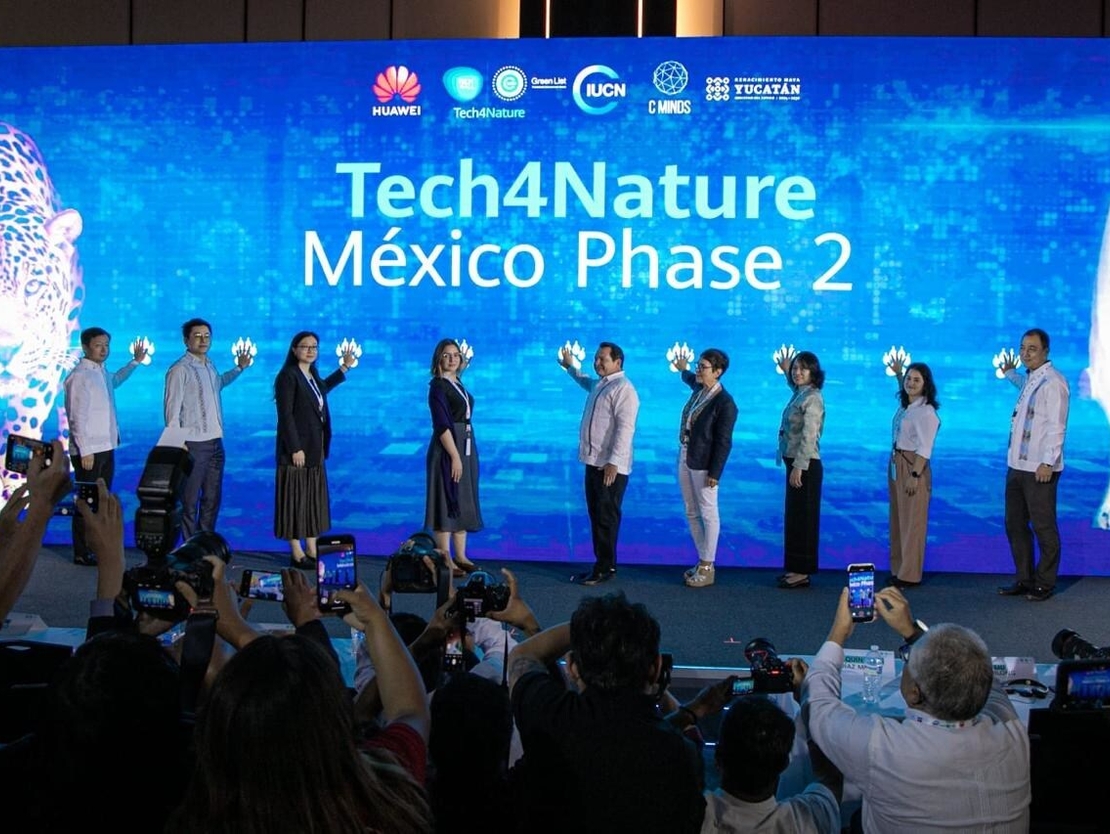
From mangrove co‑management in the Amazon coast to AI‑enabled jaguar monitoring in Mexico and smart marine monitoring in the Western Indian Ocean, 2025 marked a year of consolidation, visibility and learning for Tech4Nature, while also laying the foundations for scaling impact beyond the flagship sites.
Flagship progress: technology meeting local realities
Brazil: community‑led monitoring for climate resilience and mangrove conservation
In Brazil’s Soure Marine Extractive Reserve, Tech4Nature strengthened the role of local communities at the heart of conservation. Project partners worked closely with fishers and community representatives in Soure and Belém, including participation in the emblematic “Julho Verde” (Green July) campaign, reinforcing trust, visibility and collaboration with maritime environmental defenders.
A major milestone was the successful launch of the first Monitora Program Expedition, establishing permanent monitoring points for mangrove vegetation and the uçá crab (Ucides cordatus). The expedition marked a critical step towards long‑term, participatory monitoring of mangrove health, with local beneficiaries actively involved as field guides and data collectors.
Low‑cost climate monitoring equipment developed by the Federal University of Pará was deployed and is now generating data on water salinity and atmospheric conditions, supporting evidence‑based responses to climate change impacts on the Amazon coast.
Tech4Nature Brazil also gained national visibility when the project was featured on Globo Repórter, one of Brazil’s most widely watched television programmes, highlighting both Soure’s Green List achievement and the innovative use of technology for mangrove and climate monitoring ahead of COP30 in Belém.

China: smart monitoring for species recovery and human–wildlife coexistence
In China, Tech4Nature continued to advance science‑based monitoring in complex conservation contexts. In Hainan’s Yinggeling area, plant and animal surveys were conducted as part of an ecological restoration monitoring project at the former Gaofeng Village site. Two animal transects and 16 infrared cameras generated more than 4,000 images and videos, recording species such as small Indian civets, wild boars, porcupines, muntjaks and several bird species. These data provide a baseline for assessing the effectiveness of restoration interventions over time.
At the same time, Tech4Nature expanded its focus on human–wildlife coexistence. A new implementing partner agreement was signed with the Ecology and Nature Conservation Institute of the Chinese Academy of Forestry to develop a smart solution for human–bear conflict in Shennongjia National Park. The project will deploy AI‑powered camera traps capable of real‑time black bear identification, triggering 4G‑enabled SMS alerts to nearby residents and contributing to safer coexistence between people and wildlife.
Kenya: building the foundations for smart marine conservation
In Kenya’s Kisite‑Mpunguti Marine Park and Reserve, Tech4Nature made important progress toward technology‑enabled adaptive management of coral reef and seagrass ecosystems.
A high‑resolution bathymetric survey of Lower Mpunguti Island produced a detailed spatial model of the seafloor, capturing depth gradients, reef slopes and seabed morphology. This information is now guiding the placement of underwater monitoring systems and will enhance managers’ ability to track ecological change, inform interventions and safeguard the integrity of this internationally important marine ecosystem.
The Kenya flagship also strengthened institutional collaboration across government agencies and advanced preparations for the site’s IUCN Green List journey, positioning Kisite‑Mpunguti as a potential regional model for technology‑supported marine protected area management in the Western Indian Ocean.
Mexico: AI, connectivity and coexistence for jaguar conservation
Tech4Nature Mexico reached a series of landmark achievements in 2025, consolidating its role as a leading example of community‑centred, technology‑enabled species conservation.
Monitoring efforts were significantly expanded, increasing the continuously monitored area to 7,000 hectares and confirming, for the first time, functional connectivity across a 40‑kilometre biological corridor for jaguars. Six previously undocumented jaguar individuals were identified, providing robust scientific evidence to inform corridor protection and land‑use planning.
To strengthen coexistence strategies, the project expanded its field teams, streamlined digital data workflows and piloted a standardised protocol for responding to jaguar–livestock conflicts, reinforcing collaboration with local communities and ranchers.
Tech4Nature Mexico also gained strong international visibility. Innovations were showcased at the IUCN World Conservation Congress and the Paris Peace Forum, while local engagement was deepened through the “El Chac Mool” Festival and global media exposure during the filming of a CGTN documentary. Together, these efforts highlighted how ethical AI, community leadership and science‑based governance can work together for biodiversity conservation.
Spain: responsible technology for biodiversity and visitor management
In Spain, Tech4Nature advanced innovative approaches to balancing biodiversity conservation and human use in protected areas.
New monitoring pilots were launched to assess human activity and its impacts on bat behaviour, particularly in relation to climbing and caving activities in Sierra Nevada National Park and Parc Natural de Sant Llorenç del Munt i l’Obac. Low‑cost camera traps, acoustic recorders and light sensors were deployed, with future analysis supported by artificial intelligence.
Progress was also made on the Green List self‑assessment for Parc Natural de Sant Llorenç del Munt i l’Obac, while a pioneering legal and ethical study continued to guide the responsible deployment of digital technologies in Spanish protected areas. Led by IUCN Med with academic partners and expertise from the IUCN World Commission on Environmental Law, the study addresses data protection, ethics and governance – issues of growing importance as digital tools become more widely used in conservation.
Türkiye: establishing baselines for long‑term conservation success
In Türkiye, Tech4Nature established a new pilot site in Kazdağı National Park, where 15 camera traps have already generated more than 58,000 trap‑days of data. In partnership with the General Directorate of Forestry, the site is being developed as an integrated monitoring system combining camera traps, acoustic devices and meteorological stations.
This work will underpin Türkiye’s first baseline Green List assessment in a national protected area and support national Red List processes, providing a strong scientific foundation for long‑term conservation planning and policy.
Beyond the flagships: scaling innovation and learning globally
Alongside country‑level achievements, Tech4Nature made significant progress in global engagement, capacity building and knowledge sharing in 2025.

Innovation, awards and global dialogue
The Tech4Nature Innovation Challenge Workshops, delivered as part of the official lead‑up to the IUCN World Conservation Congress 2025, brought together 120 participants from 47 countries. Conservation professionals from NGOs, governments, academia and the private sector explored how emerging technologies – including AI, the Internet of Things, blockchain and gamification – can support area‑based conservation, ecosystem restoration and equitable governance. More than half of participants came from the Global South, ensuring diverse perspectives and experiences.
At the World Conservation Congress, the Tech4Nature Award showcased how digital innovation, combined with strong partnerships, can deliver measurable benefits for biodiversity and communities. A new PANORAMA Solutions in Focus publication was launched, featuring a curated selection of award‑winning solutions, from AI‑supported wildlife monitoring and drone applications to community‑driven NatureTech initiatives led by Indigenous Peoples, local communities, women and youth.
Across the Congress, Tech4Nature organised and participated in 14 events, launched two publications, presented two flagship impact stories, and engaged an audience of around 450 participants.
Knowledge platforms and data governance
In 2025, Tech4Nature also strengthened its contribution to global knowledge platforms. The Tech4Species page on GSAP SKILLS was launched, providing practical guidance on a wide range of technologies, including camera traps, acoustic monitoring, GPS and radio collaring, drones, blockchain, smart contracts, decentralised applications, gamification and the Internet of Things.
Recognising the growing importance of ethical and effective data use, Tech4Nature advanced the development of a Data Management Policy for Phase II. The policy will define guiding principles, standards and operational guidelines for the collection, storage, sharing and use of data generated across all Tech4Nature activities.
Looking ahead
As Tech4Nature moves toward the second half of Phase II, the achievements of 2025 demonstrate the power of combining technology, inclusive governance and local leadership. The partnership continues to generate practical lessons, scalable models and global momentum for using digital innovation in support of the IUCN Green List and the global 30×30 target.
With new satellite projects emerging in Costa Rica, the Maldives and Saudi Arabia, and growing interest from governments, communities and the private sector, Tech4Nature is well positioned to further expand its impact – ensuring that technology serves nature, people and a more sustainable future.


The 30th Conference of the Parties to the United Nation Framework Convention of Climate Change (…

Victoria Falls, Zimbabwe, 24 July 2025 — The Indo-Burma Ramsar Regional Initiative (IBRRI)…

World Wetlands Day is celebrated annually on 2 February. To celebrate this year’s theme of “…