IUCN WCEL early researchers’ view on the science-policy interfaces for the Environmental Rule of Law
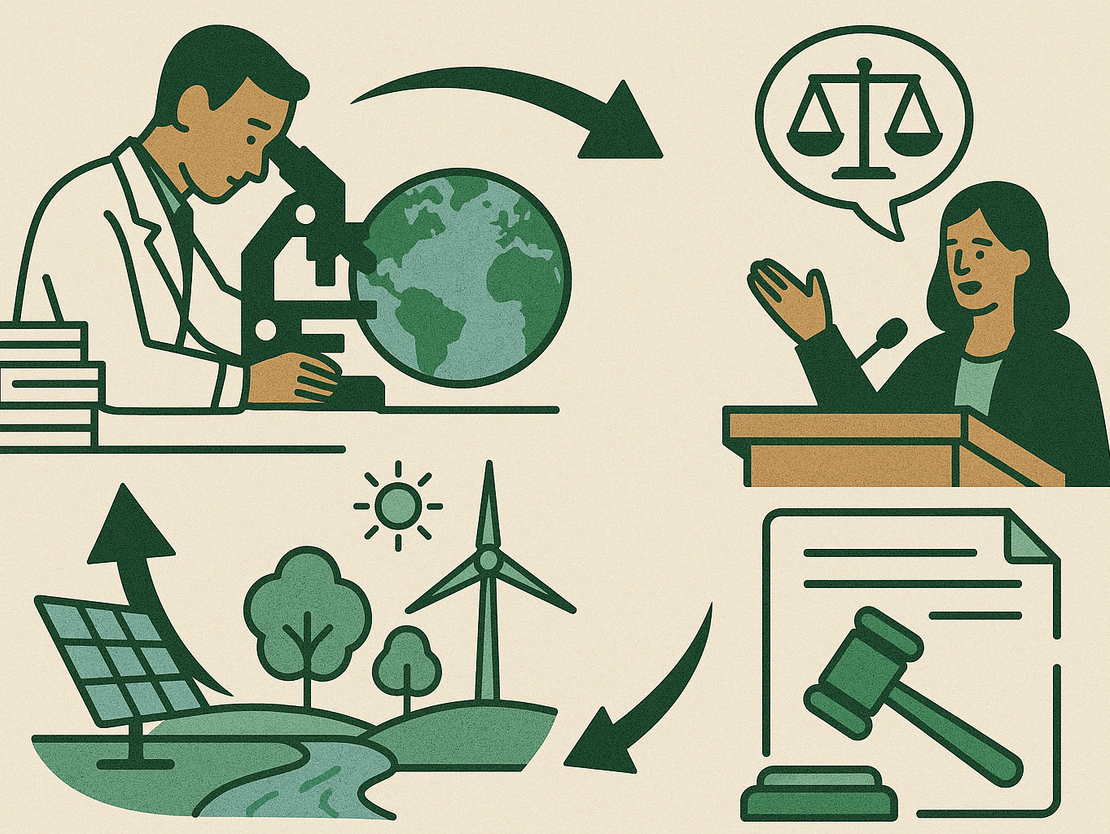
Environmental Law is, by nature, inter- and multidisciplinary. Policy-making requires scientific data, and decision-making entails “a series of questions that rarely have easy answers” (Fischer, 2017). Collaboration with science is key to enhancing the transformative power of Environmental Law by providing a scientific foundation for legal obligations (for example, the urgent need to diminish greenhouse gas (GHG) gas emissions).
Project 4 of the IUCN WCEL Early-Career Specialist Group aims to tackle the challenge between science and policy interfaces, including relations between scientists and other actors during decision-making processes to enhance the Environmental Rule of Law.
Science-policy interfaces (SPIs) "can be defined as social processes which encompass relations between scientists and other actors in the policy process, and which allow for exchanges, co-evolution, and joint construction of knowledge with the aim of enriching decision-making" (den Hove, 2007). They have been developed to identify environmental risks and propose solutions. However, there are still many challenges to ensure the relations between scientists and other actors during decision-making processes enhance the Environmental Rule of Law.
In this article, Project 4 researchers explain how their work/research interacts with the science-policy interface for the environmental rule of law and share their views on the reasons why the science-policy interface is important for the environmental rule of law, and the challenges, solutions, or opportunities to enhance it.
Dr Enrico Mezzacapo - Sant’Anna University of Advanced Studies
Enrico Mezzacapo is currently a Post-doc researcher in Agricultural, Food, and Environmental Law (AgLaw Group) at Sant’Anna School of Advanced Studies (Pisa, Italy). Enrico has experience both in academia and in international organizations (FAO, IUCN) in the field of Agri-Food and Environmental Law and policies.
Enrico’s research focuses on the role of ecological restoration in fostering ecosystem integrity and resilience in the transition toward sustainable agri-food systems. Through a legal and policy analysis, he investigates how climate, biodiversity, and conservation law interact with food systems transformation. By mapping legal instruments and assessing their coherence, his work operates at the intersection of science and law, translating ecological concepts such as resilience, ecological thresholds, and landscape connectivity into regulatory obligations and governance models.
The science-policy interface is essential for the environmental rule of law because it ensures that legal frameworks remain responsive to the complexity and dynamism of ecological systems. It allows scientific evidence to inform regulatory design, implementation, and enforcement, particularly in contexts of uncertainty and rapid environmental change. One key challenge is the rigidity of legal systems, which often struggle to integrate evolving scientific insights or adapt to socio-ecological feedback. Enhancing this interface requires institutional mechanisms for co-production of knowledge, inclusive governance, and a less anthropocentric legal approach — one that recognizes humans as an integral part of a single, interconnected socio-ecological system.
Ju-Ching Huang, S.J.D.
Ju-Ching Huang holds a Doctor of Juridical Science (S.J.D.) from Georgetown Law Center and an LL.M. from Stanford Law School. Her academic and professional focus lies at the intersection of environmental law, climate adaptation, and land use governance. She has collaborated with leading scholars and policy institutions in the United States and Taiwan to develop legal frameworks that promote resilient and equitable climate responses. She was a land use lawyer at a boutique law firm in Taiwan and later served as a policy staffer at Taiwan’s Ministry of the Interior, where she focused on land use planning and strengthening administrative due process in regulatory frameworks. She also worked as a Legal Fellow at Maryland Sea Grant, contributing to legal research on coastal resilience and environmental governance in Maryland.
Ju-Ching’s research examines how legal systems can enhance adaptive governance in flood-prone areas through a comparative analysis of the United States and Taiwan. Her doctoral dissertation analyzes both the general floodplain management frameworks in each country and project-based adaptation efforts in Maryland and Taipei. By applying an analytical framework grounded in the structural, substantive, and procedural dimensions of adaptive governance, her study highlights the challenges of integrating adaptive governance into flood adaptation while balancing democratic values such as local autonomy, property rights, and public participation. Her research demonstrates the importance of the science-policy interface in constructing legal frameworks—particularly how scientific knowledge, such as floodplain mapping and climate projections, informs legal and policy decisions in a timely and adaptive manner. This interface is essential not only for ensuring legitimacy and responsiveness in regulatory design but also for supporting iterative learning processes of adaptive governance that help democracies remain resilient amid deep uncertainty and non-stationary flood risks.
Considering the escalating climate risks, a robust science-policy interface is essential for the environmental rule of law. Scientific data is unequivocally critical to informing the legitimacy and effectiveness of environmental regulations, while legal frameworks provide mechanisms to implement and enforce that knowledge in an equitable manner.
However, significant challenges remain—not only in translating complex science into actionable policy but also in navigating the trade-offs between efficiency and inclusiveness, expert-driven decision-making and democratic accountability, and long-term resilience and short-term political or economic pressures. Ensuring public participation and maintaining transparency are critical, yet often constrained by the urgency and technical complexity of climate adaptation. Ju-Ching believes that fostering a collaborative approach that integrates scientific expertise with community engagement is essential for crafting sustainable solutions to our evolving climate challenges—recognizing that this is an ongoing process that demands sustained commitment and adaptability.
Dr Lydia Koehler, University of Plymouth
Lydia’s expertise focuses on international and regional ocean governance. She has been working on marine-related issues, including marine toxicology, reef monitoring, fisheries management, species conservation, and marine protected area management for more than fifteen years across different sectors and entities, including non-governmental organisations, universities, and regulatory bodies. Lydia holds a master’s degree in marine science and one in ocean governance and has a PhD in marine environmental law.
Lydia’s work mainly revolves around the application of existing policies and laws in the context of marine conservation and fisheries management. She is trying to understand whether current frameworks and processes are fit-for-purpose, what obstacles to the effective implementation of legal obligations exist, and how we can overcome these. This also includes how scientific data on vulnerable marine species and ecosystems are integrated and considered in decision-making at both national and regional levels.
If environmental legislation and policies are not rooted in or based on best available science, it is unlikely that they will deliver the intended conservation or management outcomes. However, some of the most pressing challenges to ensure that science forms the basis of decision-making making is how this information is presented to decision makers and what political and economic interests come into play, as these can change the course of where a decision might be taken. A potential solution to this is to communicate science across different interest groups and build strong relationships with key players.
Dr. iur. Paula Galbiatti Silveira, Hasselt University and Enhesa
Paula is a legal expert and sustainability consultant with a doctorate in law from the Bremen University (Germany) and the Federal University of Santa Catarina (Brazil). She is also a researcher at the Environmental Law Unit (ELU) of Hasselt University (Belgium), where she worked with several legal projects concerning climate change and renewable energies. Paula is also a Specified Expert in Climate & Renewable Energy Finance from the Frankfurt School of Finance and Management and the leader of Project 4 at IUCN WCEL Early Career Specialist Group. She has more than 10 years of experience in consultancy, advising multinational companies and governments, as well as academic research.
Paula’s work operates at the intersection of science, law, and policy—translating scientific evidence into legal analysis and research, compliance mechanisms, and actionable sustainability strategies. Through research with leading academics on climate litigation and EU environmental law, and contributions to projects linking scientific assessments with policy frameworks, she helps bridge gaps between technical findings and regulatory decision-making. For example, in two of her recent research projects at Hasselt University, she analysed the legal barriers and opportunities for new technologies in renewable energies, namely integrated solar panels and advanced biofuels from phytoremediation processes, proposing regulatory recommendations to enable renewable energies development within environmental and climate law frameworks in the EU.
The science-policy interface is essential for the environmental rule of law because it ensures that decision-making and enforcement mechanisms are grounded in objective, up-to-date evidence about ecological systems and human impacts. When scientific knowledge informs laws and policies, environmental governance becomes not only more legitimate and effective but also more adaptable to new challenges such as climate change, biodiversity loss, and pollution. This interface enables laws to evolve alongside scientific discovery, ensuring that fundamental rights—such as the right to clean air or a healthy environment—are protected through informed and enforceable norms.
A major challenge lies in the fragmentation between disciplines, where scientific insights often remain inaccessible to legal and policy practitioners, and where political or economic pressures dilute the integration of evidence into law. Another barrier is the translation gap—how to make complex scientific data understandable and actionable in legal and policy contexts. Strengthening this interface requires institutional mechanisms for interdisciplinary collaboration, transparency in decision-making, and participatory governance that includes scientific, legal, and societal voices. Opportunities include the use of digital tools for environmental monitoring, open data platforms, and networks that connect scientists, policymakers, and legal experts to co-create solutions. Ultimately, fostering trust, communication, and mutual understanding between these communities can reinforce the environmental rule of law and lead to more resilient, science-informed governance systems.
Ritu Dhingra, PhD
Ritu Dhingra is an Environmental Law and Policy Consultant at Law Linkers and Company, with chambers in the Delhi High Court. She holds a PhD in Environmental Law, with expertise in forest and biodiversity laws, and sustainable development in India. She authors books and papers on environmental law and conservation, and has written five books on the subject since 2015. She also teaches environmental law at universities and delivers pro bono lectures to promote awareness and understanding of environmental issues.
Ritu’s research and work focus on promoting sustainable development and conservation of natural resources. She delivered a lecture on the science-law interface, highlighting the importance of interdisciplinary approaches in environmental law. She is currently working on a series of books on this topic, which will be published on Kindle Direct Publishing soon. Her PhD research explored laws related to biodiversity and forest conservation in India, with a specific emphasis on the role of technology in conservation efforts. She is committed to continuing her research in this area and exploring ways to promote a deeper understanding of the science-law interface.
The interface between science and law is crucial for the environmental rule of law because environmental law is deeply rooted in environmental science. The conservation of biodiversity, ecology, and natural resources relies heavily on a thorough understanding of scientific principles. Environmental science encompasses various disciplines, including biology, ecology, geography, and climate science, all of which are interconnected and interdependent within the biosphere. A strong foundation in environmental science is essential for crafting effective laws and policies that promote sustainability, conservation, and environmental protection. By integrating scientific knowledge into legal frameworks, we can ensure that environmental laws are informed, effective, and adaptable to emerging challenges, ultimately supporting the well-being of both human societies and the natural world.
Here are a few points to emphasise the importance of the science-law interface in environmental governance, including:
- The interconnectedness of various scientific disciplines within the biosphere;
- The need for effective laws and policies that promote sustainability and conservation; and
- The benefits of integrating scientific knowledge into legal frameworks, such as informed decision-making and adaptability to emerging challenges.
Additional information:
If you want to know more about Project 4, please visit our webpage at https://iucn.org/our-union/commissions/group/iucn-wcel-early-career-specialist-group
Disclaimer
Opinions expressed in posts featured on any Crossroads or other blogs and in related comments are those of the authors and do not necessarily reflect the opinions of IUCN or a consensus of its Member organisations.
IUCN moderates comments and reserves the right to remove posts that are deemed inappropriate, commercial in nature or unrelated to blog posts.