Forests and Grasslands at UNFCCC COP30: Spotlighting the value of terrestrial ecosystems for climate change adaptation and mitigation
In November, the IUCN Forest and Grasslands Team participated in IUCN’s delegation to the 30th convening of the Conference of the Parties (COP30) to the United Nation Framework Convention on Climate Change (UNFCCC) in Belém, Brazil. At the conference, the team organised several events to spread awareness on the importance of forest and grassland ecosystems in the context of climate change—bringing together Ministers, Indigenous leaders, scientists, policymakers, and community stakeholders from around the world.
Photo: IUCN

Photo: IUCN
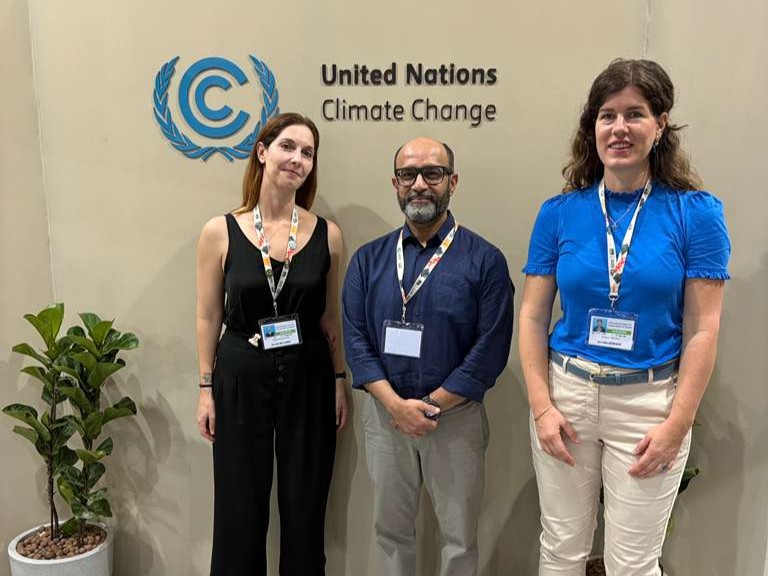
Photo: IUCN

This year, UNFCCC COP30 took place in Belém, Brazil—a city which cts as a gateway to the Amazon rainforest. Subsequently, forest ecosystems and their relationship with climate change were at the forefront of many discussions, including several events organised and participated in by the IUCN Forest and Grasslands Team. These discussions brought together stakeholders from around the world to deliver a clear message: conserving ecosystems, including forests like the Amazon and grasslands like the Cerrado in Brazil, is essential to achieving climate goals. This requires finance, political will, and collaboration and cooperation across governments, civil society, the private sector, and the communities who depend on and steward these landscapes.
“COP30 delivered some clear progress for forests, including new finance through the Tropical Forests Forever Facility, stronger Amazon monitoring cooperation and progress on Indigenous land recognition,” said Chetan Kumar, Global Head of the IUCN Forest and Grasslands Team. “At the same time, our Team helped revive the central role of restoration and community-led action where deforestation cannot be prevented. These outcomes give us a better base to build on, even as the path to 2030 becomes more demanding.”
Restoring ecosystems for climate resilience: Global goals and local lessons
On November 17th, the IUCN Forest and Grasslands Team hosted the high-level session “The Bonn Challenge: 15 Years of Forest Landscape Restoration for Climate, Nature & People,” hosted by Global Landscapes Forum (GLF) Climate 2025. The event commemorated the Bonn Challenge, the world’s largest landscape restoration initiative, and outlined a roadmap for the future. The Bonn Challenge was launched as a joint initiative by the Government of Germany and IUCN in 2011 with the goal of restoring 150 million hectares by 2020. The challenge has now far surpassed this goal, aiming to restore 250 million hectares by 2030. The session brought together important voices in forest restoration, including Ministers from Armenia, Brazil, Burkina Faso, Guatemala, Germany, Mongolia, and Switzerland, alongside scientists and experts to reiterate the importance of continued and diverse efforts to restore degraded and deforested ecosystems. This event also highlighted recent pledges made to support restoration, such as Switzerland’s investment of CHF 5.2 million in the Forest Landscape Restoration (FLR) Hub.
The IUCN Forest and Grasslands Team also hosted the session “Scaling Restoration for Sustainable Agriculture through Innovative Finance: Unlocking Landscapes for Prosperity” on November 19th in the AgriZone. This event bridged global ambition and local delivery by connecting policy to finance-ready restoration projects in agriculture—aligning climate, biodiversity and land goals. The event convened stakeholders and specialists across agriculture fields, creating a comprehensive picture of finance and sustainable agriculture’s role in achieving restoration targets.
Conserving intact ecosystems through stakeholder engagement and evidence-based decision making
Events went beyond restoration, also highlighting the importance of conserving and protecting intact and high-integrity ecosystems. In the UNFF Pavilion on November 20th, the IUCN Forest and Grasslands Team organised the session “Safeguarding Primary Forests in a Fiery World: A Call for Global Stewardship.” Primary forests are among the planet’s most irreplaceable ecosystems; however, as global environmental issues like climate change, biodiversity loss, gender inequality, and natural disasters become increasingly frequent, severe, and persistent, these landscapes are under threat on every front. Through discussion of scientific evidence and exploration of forest management strategies, like integrated fire management and Indigenous and traditional practices, the event spotlighted the continued need for primary forest conservation—reminding audiences of these forests' pivotal role in the climate and biodiversity agenda and their invaluable contributions to international agreements such as the Paris Agreement, the Kunming-Montreal Global Biodiversity Framework (GBF), and Land Degradation Neutrality (LDN).
Sharing success stories and building momentum: How IUCN is forging solutions
Outside of events, the IUCN Forest and Grasslands Team was proud to have contributed to the publication of several important reports and products. This includes: the 2025 Amazon Assessment Report of the Science Panel for the Amazon; the joint IUCN, Equilibrium Research, and WWF report titled “Protecting the Overlooked Carbon Sink: A Policy Agenda for Grasslands;” a technical brief for COP30 covering forests and climate change; the paper “Lessons and Challenges of a Restoration Flagship: The Trinational Atlantic Forest Pact” written by the IUCN-led Science Task Force (STF) of the UN Decade on Ecosystem Restoration; and a series of briefs on the International Model Forest Network (IMFN) and how Model Forests can help the international community achieve environmental and sustainable development goals.
IUCN is committed to the protecting, conserving, and restoring nature and our planet’s terrestrial ecosystems, from forests and farms to grasslands and deserts. COP30 provided a crucial space to address the existential ways in which climate change is affecting, and is affected by, the health of these ecosystems. Although not all outcomes were positive—there is still considerable work to be done to protect forests and phase out fossil fuels, commitments which must be grounded in finance and genuine political will—there is an opportunity capitalise on the lessons and dialogues from COP30. By continuing to work with partners and communities to bring global science, policy, and practice together to advance climate change adaptation and mitigation alongside nature conservation, we can address the climate crisis.
The IUCN Forest and Grasslands Team was represented at COP30 by: Chetan Kumar, Global Head; Paula Prist, Senior Programme Coordinator; and Anique Hillbrand, Senior Programme Officer.


The 30th Conference of the Parties to the United Nation Framework Convention of Climate Change (…

Victoria Falls, Zimbabwe, 24 July 2025 — The Indo-Burma Ramsar Regional Initiative (IBRRI)…

World Wetlands Day is celebrated annually on 2 February. To celebrate this year’s theme of “…