IUCN develops and disseminates effective knowledge products, evidence, guidance, metrics tools and training, targeting different stakeholders from the food and agricultural systems and conservation communities to strengthen capacity in using them.  

These activities and products support stakeholders in their decision making from policy to investment to project development, towards achieving sustainable food and agricultural systems. 

Publications to guide policy making

IUCN Flagship Report Series

The IUCN Flagship Report series seeks to draw from multiple lines of evidence: novel analysis to bring together data based on IUCN standards, with authoritative external datasets and integrated assessment models; structured narrative literature review and synthesis; and case studies and examples from around the world. Policy makers can find the Flagship Report and other policy guidance in this section. 

The report is available in English and Arabic.

Sustainable agriculture and NbS

Nature-based Solutions (NbS) have the potential to provide a “triple-win” for people, planet, and economy, offering a valuable pathway for farmers, businesses, and conservationists. NbS is now a widely used concept in many sectors and among decision-making bodies.

A series of IUCN publications aim to provide the basis for effective use of NbS, focusing on the relationship between sustainable agricultural practices and the concept of Nature-based Solutions, and specifically the applicability of the IUCN Global Standard for NbS in agricultural contexts. 

More here

The Land health monitoring framework

The Land health monitoring framework introduces a holistic approach to assessing biodiversity and habitat diversity within agroecosystems. By offering a flexible framework that integrates a large range of existing tools and indicators, this report addresses the challenge of measuring land health – and the accompanying benefits it brings through various ecosystem services – at multiple scales. 

The Regen10 Outcomes-Based Framework

Supported by IUCN Regen10 is developing an Outcomes-Based Framework for the transition to regenerative food systems in consultation with farmers, businesses, civil society groups and other food system actors. The Framework aims to equip all food system actors with a shared understanding of how to advance regenerative food systems, and a ‘North Star’ that will guide them to make decisions that accelerate the transition to regenerative – recognizing that the responsibility for this transition should be shared across the value chain. It will also help them track and measure the changes that occur over time in farms and landscapes.


IUCN

As a complementary document to the Land Health Monitoring Framework report, a guidance note – Monitoring land health in agricultural landscapes – is now available, providing a step-by-step process to select indicators, develop monitoring protocols, and implement biodiversity tracking across scales in agricultural areas.


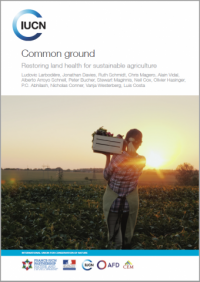
The Common ground report

The Common ground report shows how achieving greater sustainability closely depends on agriculture, and how the future of farming relies on Nature and biodiversity conservation. Therefore reaching consensus between the worlds of agriculture and conservation is critical. The report concludes that a common ground for mutually beneficial action exists, and makes a series of recommendations which would improve the situation further.

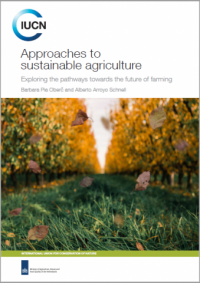
Approaches to sustainable agriculture 

Sustainable agriculture needs to consider two inseparable, intertwined societal priorities – preserving the environment and providing safe and healthy food for all.  This report shows that different approaches to sustainable agriculture exist, that they have a number of important commonalities, but also that their diversity is a strength in itself. The challenge is to enable dialogue and create the market or regulatory environment that will help prioritise according to local contexts.

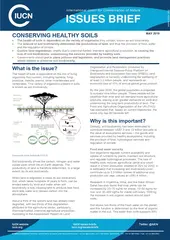
Conserving healthy soils

IUCN Globally, soil biodiversity has been estimated to contribute between US$1.5 and 13 trillion annually to the value of ecosystems services – the goods and services provided by healthy ecosystems, including the provision of food, hydrological services and regulation of climate. Current land degradation, chiefly due to chemical-fuelled, intensive agricultural production, is causing the loss of soil biodiversity, undermining the services provided by healthy soils. IUCN recommends that Governments should put in place policies and legislation, and promote land management practices which restore or preserve soil biodiversity.