New IRENA-CREEI-IUCN report highlights how solar PV can support nature-positive energy transitions
Abu Dhabi, United Arab Emirates | 10 January 2026 — A new joint report by the International Renewable Energy Agency (IRENA), the China Renewable Energy Engineering Institute (CREEI) and the International Union for Conservation of Nature (IUCN) shows how large-scale solar photovoltaic (PV) projects can minimise environmental risks while delivering benefits for biodiversity, ecosystems and local communities.
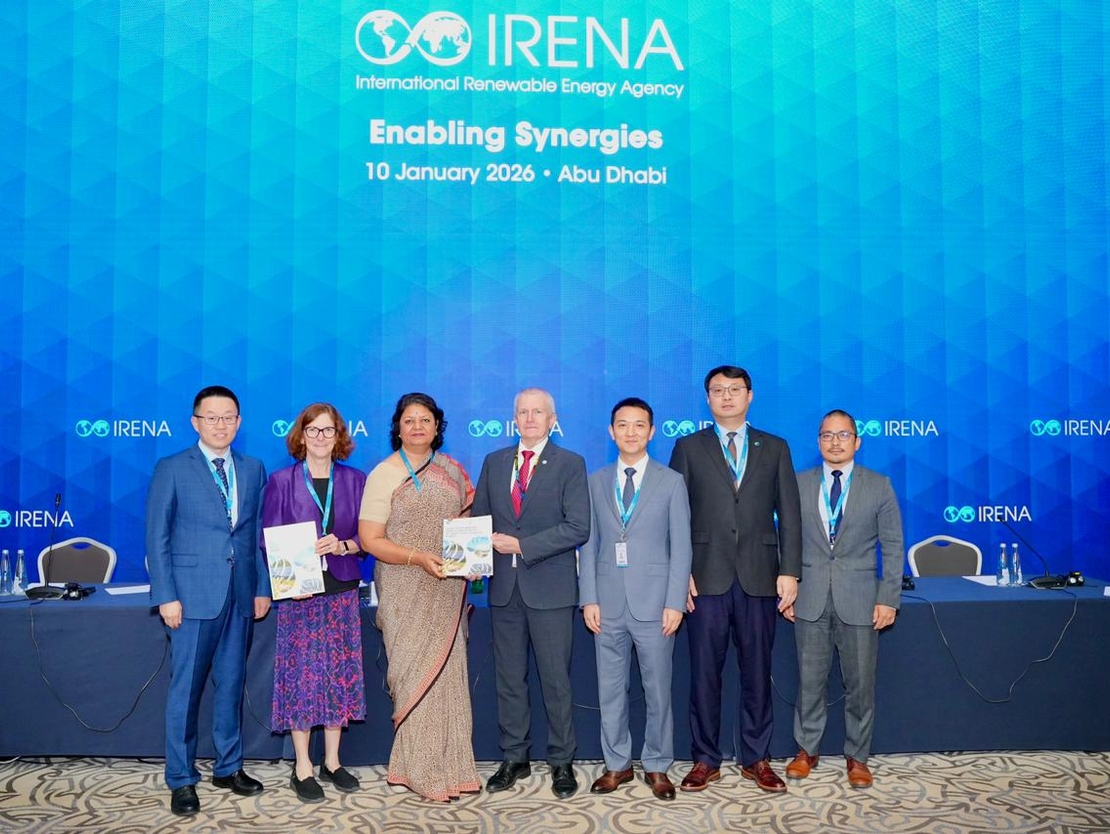
From left to right, Yuetao Xie, CREEI; Ute Collier, IRENA; Gauri Singh, IRENA; Stewart Maginnis, IUCN; Li Xiang, National Energy Administration (NEA); Hao Jiang, CREEI; and Jinlei Feng, IRENA.
Launched during the 16th IRENA Assembly in Abu Dhabi, the report — Local Environmental Impacts and Benefits of Large-scale Solar PV Plants — comes at a time of rapid global expansion of solar energy. In 2024, solar PV accounted for 42% of global installed renewable capacity and is projected to deliver nearly half of the renewable capacity needed by 2050 to meet global climate and energy goals.
“Solar photovoltaics has been leading the expansion of renewable energy capacity worldwide. With the right measures and policies, large-scale solar PV plants can also contribute to enhancing ecosystem services that are linked with agriculture, food, and water, as well as improving the lives of local communities. Its deployment, however, must take into account the impact on environment and biodiversity. I am convinced that through this collaboration with CREEI, Qinghai Province, IUCN and other partners, we can raise awareness and further support the deployment and use of solar PV more sustainably, which would benefit both local environment and communities.” - Gauri Singh, Deputy Director General at IRENA
Unlocking environmental co-benefits
Beyond avoiding harm, the report highlights how well-designed solar PV projects can actively contribute to positive environmental outcomes. Across regions, emerging evidence shows that solar PV can be planned and managed to meet energy needs while simultaneously supporting biodiversity, ecosystems and local livelihoods.
“Across all continents, we are beginning to see how solar PV can be designed to optimise its contribution to addressing energy, climate and biodiversity challenges,” said Stewart Maginnis, Deputy Director General at IUCN. “Approaches such as agrivoltaics allow energy generation and land productivity to coexist, helping to regenerate soils and increase on-site biodiversity. In arid and semi-arid regions, well-designed projects can restore degraded land, create favourable microclimates and combat desertification.”
The report also points to models such as solar grazing, which integrate livestock management with renewable energy infrastructure, supporting rural livelihoods while maintaining habitats. Through strong partnerships, innovative design and community engagement, IUCN emphasises that scaling proven, nature-positive solutions can ensure the expansion of solar energy goes hand in hand with biodiversity conservation, local prosperity and inclusive development.
Strengthening policy and partnerships
Jiang Hao, Lead Scientist at CREEI, noted that CREEI has consistently supported close and structured cooperation between China, IRENA, IUCN and other international organisations across key areas including planning, policy, technology and industry. He highlighted the joint research report as a tangible outcome of this long-standing collaboration.
Looking ahead, and under the guidance of China’s National Energy Administration (NEA), CREEI will further strengthen research cooperation with countries and international organisations worldwide, with the aim of positioning renewable energy not only as a cornerstone of the global energy transition, but also as an enabling force for local economic development and environmental stewardship.
The report calls for integrated spatial planning, consistent use of environmental and social impact assessments, and stronger policy and financial incentives to scale nature-positive solar PV. It also emphasises the importance of collaboration between the energy and conservation sectors.
The launch builds on the Memoranda of Understanding (MoUs) signed between IRENA and IUCN at the IUCN World Conservation Congress in Abu Dhabi in October 2025, and between CREEI and IUCN at the 15th IRENA Assembly in Abu Dhabi in January 2025.
Read the full report: Local environmental impacts and benefits of large-scale solar PV plants


El sistema keyline o línea clave, impulsado por la UICN en el altiplano occidental de Guatemala, a...

La UICN y su Comisión de Gestión de Ecosistemas publican estudio sobre la aplicación del Estándar...

Delegación del Ministerio de Desarrollo Agropecuario de Panamá visitó Guatemala para conocer la...